Make Me A Tritium Sandwich!
For tritium to be used effectively in a lattice compound within a hypersonic missile system, it would need to be encapsulated or bonded into a stable, high-temperature-resistant matrix that can manage both its radioactive decay and thermal flux. Here are a few advanced options that materials scientists might explore:
1. Tritium-Stabilized Ceramic Lattice (TCL)
• Base Materials: Zirconium carbide (ZrC) or hafnium carbide (HfC)
• How It Works: Tritium is embedded in microvoids or grain boundaries within the ultra-high-temperature ceramic.
• Benefit: UHTCs already withstand >3500°C; tritium decay energy helps reinforce localized heat dissipation.
• Use Case: Nose cones, thermal shields
2. Tritium-Hydride Alloy Matrix
• Base Materials: Titanium tritide (TiT₃), or palladium tritide (PdTₓ)
• How It Works: Tritium forms stable metallic hydrides with selected alloys.
• Benefit: Controlled slow-release of decay energy into an AI-regulated thermal battery.
• Use Case: Internal heat-to-power conversions for guidance systems
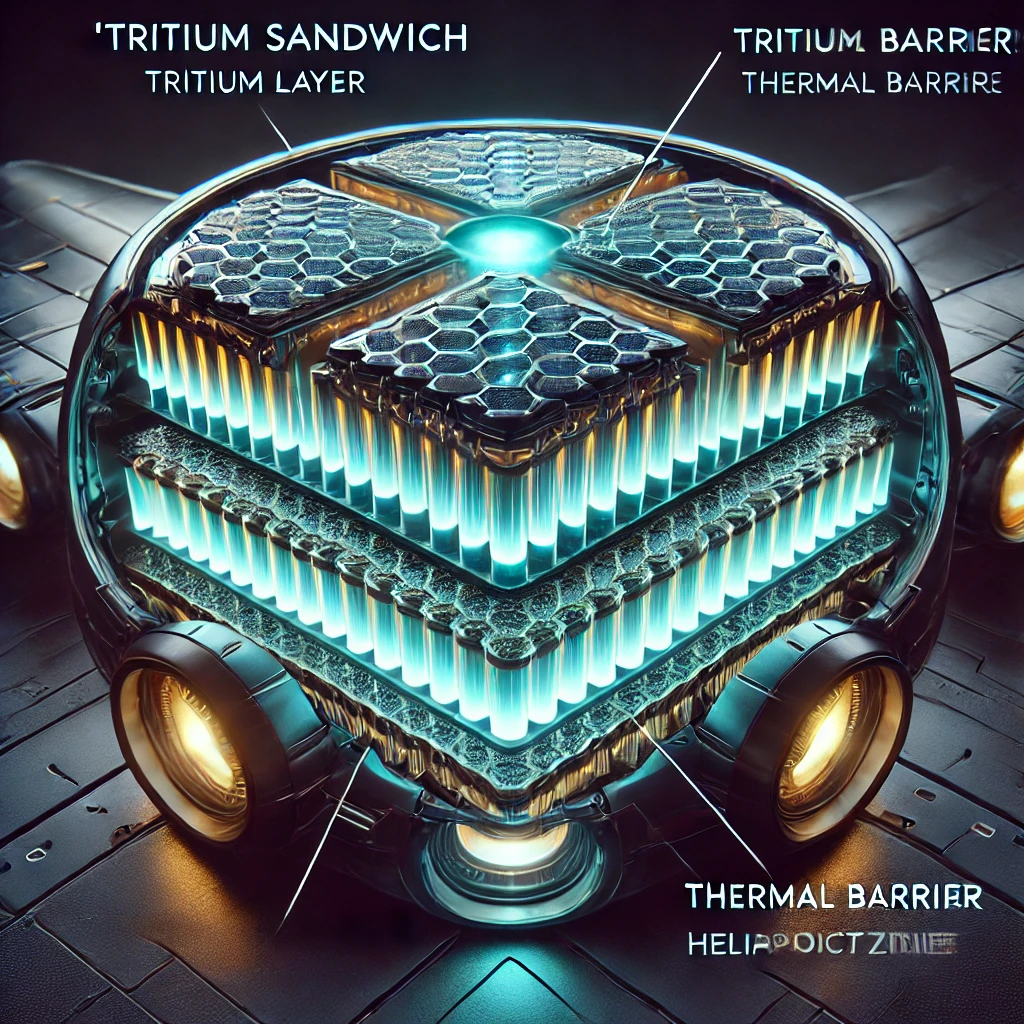
3. Graphene-Tritium Sandwich Layer
• Base Materials: Graphene monolayers + tritium ions embedded via ion implantation
• How It Works: Tritium ions are trapped between graphene layers, minimizing escape and localizing decay.
• Benefit: High heat conductivity of graphene + controlled radiation makes this excellent for edge cooling or radar-absorbing skin.
• Use Case: Skin shielding, AI radar cloaking
4. Metal-Organic Framework (MOF) Encapsulation
• Base Materials: MOFs like UiO-66 or MIL-101 functionalized with hydrogen/tritium binding sites
• How It Works: Tritium atoms are adsorbed into the MOF pores and held in place by chemical affinity.
• Benefit: High surface area allows light mass shielding with controlled decay energy diffusion.
• Use Case: Lightweight hypersonic drones or maneuvering kill vehicles (MKVs)